Summarize This Article with AI


How do you start a faceless YouTube channel without showing your face, your room, or your questionable tech setup? Good question. Thousands of people want in on YouTube, but the second a camera turns on, their confidence disappears.
One database tracking faceless channels identified more than 13,000 channels, with some generating millions of monthly views and reaching significant revenues. No face. No fame. Just smart content and systems. And pretty much anyone can do it.
So, this isn’t some generic “follow your passion” speech. We’re breaking down the actual playbook – from choosing the right niche and creating faceless videos to growing your audience.
Key Takeaways
- Faceless YouTube channels let creators publish without appearing on camera.
- Choose a niche with demand and plenty of repeatable content ideas.
- Strong scripts, branding, visuals, titles, and thumbnails support channel growth.
- AI can simplify production, but original value and creative input still matter.
- Use YouTube Analytics to understand performance and improve future videos.
- Faceless channels can monetize through ads, sponsorships, affiliates, fan funding, and products.
Understanding the Faceless YouTube Channel
A faceless YouTube channel is exactly what it sounds like: no on-screen person, but still very much driven by a creator. The face is gone, not the personality. Your ideas, writing, pacing, and editing do all the talking.
There are two main lanes most faceless YouTube channels fall into:
- Traditional faceless channels: You’re still hands-on. You script, edit, pick visuals, and maybe record voiceovers. Think storytelling, tutorials, commentary, and educational content. It’s you, just off-camera.
- Automated-style channels: More system-driven. You might outsource scripts, voiceovers, and editing, or use AI tools to speed things up. This is where “YouTube automation” gets thrown around (often badly, let’s be honest).
Either way, faceless doesn’t mean soulless. If anything, it forces you to focus on what actually matters: ideas people care about and videos they’ll actually sit through.
Major Benefits of a Faceless YouTube Channel
Here’s why this whole faceless YouTube thing isn’t just a workaround. In fact, it’s actually a cheat code if you play it right.
- Stay anonymous: You can build a full channel without tying it to your real identity. No worrying about coworkers, family, or random internet weirdos. You control what people see, what they know, and how visible you actually are.
- Less on-camera pressure: No lighting setup, no “where do I put my hands,” no re-recording because your face looked weird mid-sentence. If you’re camera shy, this removes the biggest mental block and lets you actually start making videos consistently.
- Simple to scale: Once you lock in a format, you can repeat it: same structure, different topic. You can batch scripts, reuse editing styles, and even outsource parts later. That’s how faceless content turns into a system instead of a one-person grind.
- Wider topic choice: Some niches just work better without a face – think animations, deep-dive explainers, or using stock footage to tell stories. You’re not boxed into “talking head” content, which opens up far more creative directions.
Ultimately, the biggest advantage is flexibility. You can choose a format that suits your skills, budget, and niche, then build a production process you can realistically maintain. You stay behind the scenes while your ideas, storytelling, and creative style become what viewers recognize.
How to Create a Faceless YouTube Channel: Step-by-step Instructions
So, this is where you either build something real… or get stuck watching “how to start” videos for six months straight. We’re not doing that. This is the actual build phase.
1. Choose Your Niche
Your niche is everything. It decides what you make, who watches, and whether this turns into a hobby or something that can actually pay. Pick wrong, and you’ll run out of ideas fast. Pick the right niche, and you’ve got infinite scope.
Here’s the simplest test: Can you list 20–30 video ideas in 10 minutes without forcing it? If yes, you’re onto something. If you’re stuck at five and already reaching… yeah, that niche is going to dry up real quick.
Check out Kurzgesagt in a Nutshell – they took complex science and turned it into clean, visual storytelling. Same format, endless topics, extremely bingeable. That’s the goal: a niche that feeds itself so you’re never stuck wondering what to make next.
2. Research Competitors and Plan Your Content
They always say “don’t copy others.” But it’s only a half-truth. You absolutely should study what’s already working – just don’t be lazy about it. This is recon, not reproduction.
Start by stalking 5–10 channels in your niche. Not casually – properly. What format are they using? How long are their videos? What kind of video titles are pulling views? Which ones flop? There’s a pattern in what videos perform, and it’s not random.
Pay attention to.
- Formats: Look for repeat formats (same idea, different topic = gold).
- Popular Videos: Check their most viewed vs. most recent uploads.
- Titles & Thumbnails: Scan thumbnails – busy vs. clean, text vs. no text.
- Read comments – what do people want more of?
Then turn that into actual ideas. Not “research notes”, real, usable video ideas you can film tomorrow. Aim for at least 15–20 before you even upload your first video. That’s how you avoid the classic “I posted twice and now I’m out of ideas” spiral.
3. Creating a Channel Identity Without a Face
No face means your branding has to work harder. This is what makes people recognize you in a sea of content – not you, but your vibe.
Your channel name, thumbnails, logo, banner, tone – all of it matters more now. Your thumbnails, especially, are your first impression. If they don’t grab attention, nothing else gets a chance. The same goes for your overall style – are you clean and minimal, chaotic and funny, or dark and documentary-style? Pick something and stick to it.
Consistency is key. If every video looks and feels different, people won’t remember you. If everything feels connected, you build recognition fast – even without showing your face.
The best example is Lofi Girl. Its recurring illustrated character, visual aesthetic, music format, and overall mood create a recognizable identity without relying on an on-screen creator.
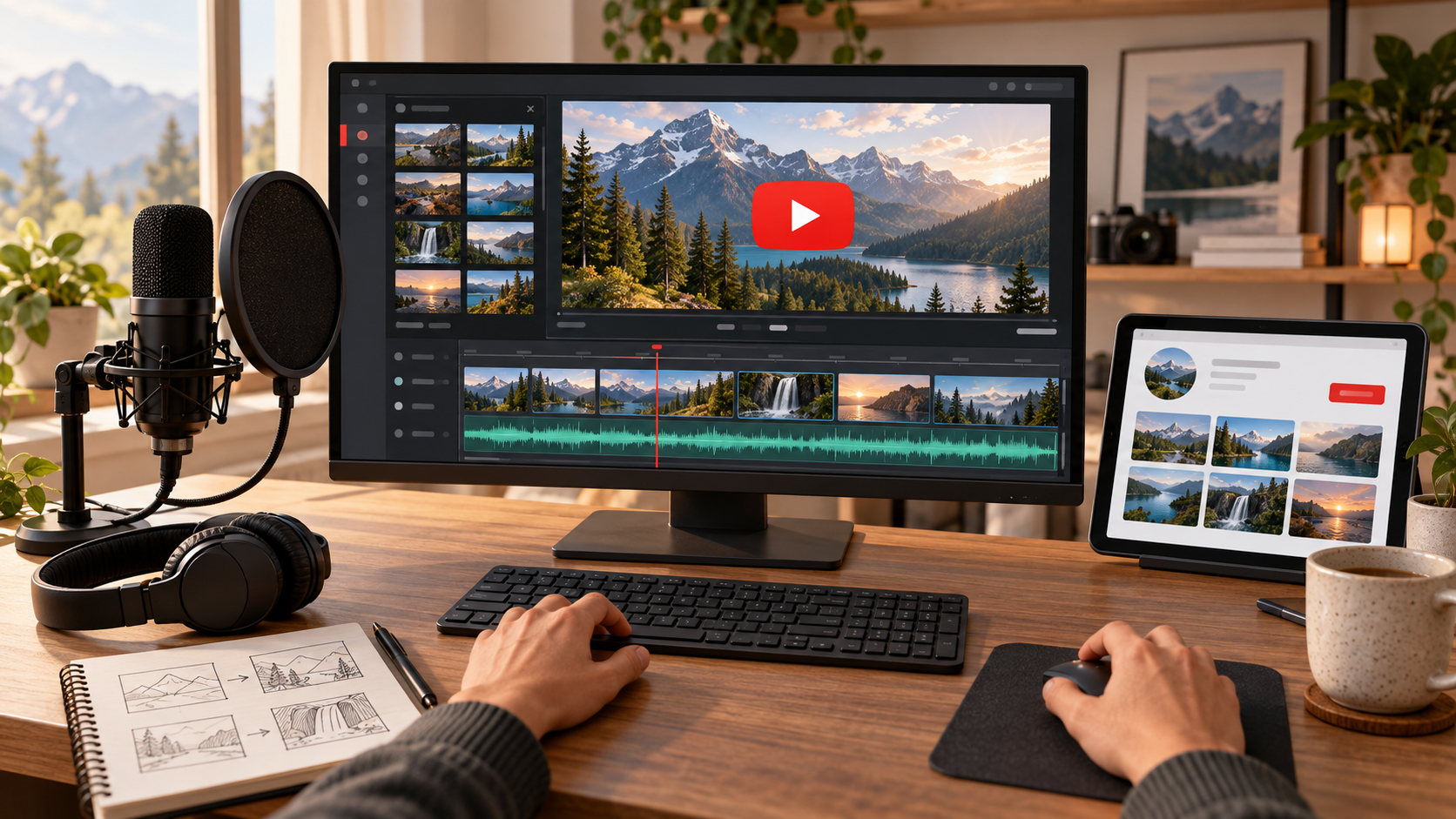
4. Turning a Script Into a Finished Video
This is where a lot of people overcomplicate things and then mysteriously never upload. Relax – you’re not directing a Netflix doc. You’re building a repeatable system.
- Start with voiceovers: Record it yourself or use a solid AI voice—just don’t make it sound like a GPS giving life advice—clean, natural, and easy to follow wins.
- Then build visuals around it . Use stock footage, images, screen recordings, clips, or animations depending on your format. You’re matching visuals to ideas, not the other way around.
- Keep your footage moving: Static equals boring. Even simple zooms or cuts keep attention up.
- Assemble the full video in layers: narration → visuals → music → final polish.
Why nail that voiceover first?
- It locks the pacing. You know exactly how long each section needs to be, rather than guessing.
- It stops you from over-editing random visuals that don’t actually fit the story.
Keep the process simple enough that you can repeat it without frying your brain, because making videos once is easy, and doing it 30 times? That’s the real game.
5. Optimize Titles, Thumbnails, Description
Your title and thumbnail help viewers decide whether your video is worth clicking, while your description gives YouTube and viewers additional context about the content.
- Write Compelling Titles: Put clear keywords in your title and description so the internet (and YouTube) knows what your video is about—no mystery novels.
- Front-load the title – the important words go first, not buried at the end.
- Use curiosity, but don’t clickbait yourself into disappointment. If the video doesn’t match, people bounce.
- Create Custom Thumbnails : Thumbnails need contrast, clarity, and one obvious idea, not ten tiny things fighting for attention.
YouTube says that 90% of its best-performing videos have custom thumbnails. That doesn’t mean a custom thumbnail guarantees strong performance, but it shows why creating one should be a standard part of your publishing process.
Before publishing, look at your title and thumbnail together and ask one question: would someone unfamiliar with your channel immediately understand what the video offers?
6. Consistency Over Random Uploads
Uploading five videos in a burst and then disappearing for three weeks? That’s how you confuse both your audience and the YouTube algorithm in one move.
Consistency isn’t about grinding daily uploads like a maniac. It’s about being predictable. People watch channels they can rely on. The same applies to the algorithm – it learns your rhythm and who to show your content to based on that pattern.
- Pick a schedule you can actually maintain (once a week > five random uploads, then burnout).
- Match your format to your capacity – don’t promise documentaries if you can barely finish short videos.
- Batch your work – script or edit multiple videos in one go to stay ahead.
Schedule your YouTube videos when you can comfortably maintain. Once your production process becomes faster and more predictable, you can decide whether increasing your upload frequency makes sense.
7. Accelerate Your Channel’s Growth
When a channel looks empty, people hesitate. Low views, zero subscribers – it feels like walking into an empty restaurant. So, you can choose to buy YouTube subscribers and views to give your channel a bit of early “this is alive” energy.
And honestly? It can work if it’s legit—real users, real engagement—no bots, no sketchy nonsense that affects your channel later. Otherwise, you’re just inflating numbers that don’t translate into actual growth.
But let’s be clear – this is a boost, not a backbone. If your content doesn’t engage, doesn’t hold attention, doesn’t make people care, no amount of numbers saves you. The push might get eyes on your videos, but keeping them? That’s on you.
8. Getting Your Videos Seen Beyond YouTube
Relying only on YouTube to push your videos is like opening a shop and hoping people just wander in—bold strategy, but doomed to fail.
If you want actual traction, you need to post your content where people already are – TikTok, X, Instagram, anywhere your audience is scrolling instead of working. This is how you attract potential viewers who would never otherwise find your channel.
- Chop your full video into short clips – hooks, punchlines, key moments.
- Reformat for vertical and fast pacing (no slow intros; you’ve got 2 seconds max).
- Add captions – most people watch on mute.
- Drop links back to your channel so there’s a clear path to the full video.
And here’s the kicker: Don’t build on just one platform. Research into creator behavior found that adding a second platform increased followers by 23.5% and engagement by 25.4% on the creator’s main platform because audiences discovered through one platform spill over into another.
The takeaway isn’t that you need to be everywhere. Choose one or two additional platforms where your target audience already spends time and repurpose your strongest content strategically.
9. Track Your Analytics and Improve
Most creators open YouTube Analytics, see a bunch of graphs, and then change absolutely nothing.
This isn’t about “checking stats.” It’s about reading what your videos are trying to tell you – because every drop, spike, and flatline is basically viewer behavior in disguise.
- Click-through rate (CTR): This is your first impression. If it’s low, your video titles or thumbnails aren’t doing their job. People aren’t even giving you a chance.
- Audience retention: This is where the truth hurts. If people dip in the first 10–20 seconds, your hook is weak. If they leave halfway, your pacing or structure is off.
- Traffic sources: These tell you how you’re being discovered – search, suggested, browse. Each one needs a slightly different approach with keywords and format.
- Watch time: This is what actually drives video growth. Not views, not likes – time. If people stay, your videos perform. Simple as that.
Here’s the real move: don’t panic and rebuild everything after one bad video. That’s how people spiral.
Instead, treat each upload like a test. One tweak at a time – maybe tighter intros, better thumbnails, sharper hooks. Let the data respond. That’s how you go from “posting stuff” to actually understanding why people watch.
Top YouTube Faceless Niches to Build in 2026
Picking a niche isn’t about what sounds cool at 2 am – it’s about what actually holds attention, repeats well, and can make money without you burning out. The best faceless content sits right in that sweet spot: high demand, repeatable format, solid monetization.
Here’s where things are hitting right now:
- Personal Finance & Investing: This is where the real money is. Credit cards, side hustles, investing basics – advertisers love it, which means higher payouts. Simple formats like “X mistakes” or “How X works” can run forever.
- AI & Technology: Everyone’s trying to keep up with AI without losing their mind. Tools, breakdowns, tutorials – endless content. It’s a fast-moving niche, but if you stay sharp, you ride the wave instead of chasing it.
- Kids Education & Animation: Massive scale. Like, ridiculous scale. Cocomelon didn’t hit 220 billion views by accident—bright visuals, simple storytelling, repeatable formats – perfect for faceless production.
- Gaming Stories & Analysis: You don’t need to be on camera to talk about games. Deep dives, lore breakdowns, “what went wrong” videos – gamers will happily watch 20 minutes of this while eating cereal at 3 a.m.
- True Crime & Mystery: Built for retention. Once someone clicks, they’re staying to find out what happened. Strong storytelling + atmosphere = long watch time. Perfect for voiceovers and controlled visuals.
- History & Documentary: Evergreen gold. A good history video can keep pulling in views for years. Wars, empires, weird forgotten events – same format, infinite topics, steady traffic long after you hit upload.
- Health & Fitness: Always in demand. From “why diets fail” to “science of muscle growth,” people are constantly searching. Clean visuals, clear explanations, no face needed – just credibility and clarity.
- Luxury, Business & Wealth Stories: People love peeking into expensive worlds they don’t live in. Billionaire breakdowns, brand stories, “how X got rich” – high curiosity, strong click potential, and great for ads and sponsors.
Real World Faceless YouTube Channel Examples
Faceless content isn’t limited to one niche or production style. Here are some established channels that show how different approaches can work without making an on-screen creator the focus:
- MagnatesMedia : Creates cinematic business documentaries using narration and visuals without an on-screen host.
- HowToBasic : Uses an anonymous, visual-comedy format built around unconventional how-to videos.
- BRIGHT SIDE : Produces animated explainers, facts, riddles, and educational content without relying on an on-screen host.
- PolyMatter : Covers business, economics, geopolitics, and technology through narrated visual essays.
- neo : Creates visual documentaries covering geography, politics, infrastructure, society, and related subjects.
The Real Income Sources Behind Faceless Channels
Faceless channels can earn money in the same ways as other YouTube channels. For creators in the YouTube Partner Program, advertising is one of the most established options.
YouTube says creators receive 55% of the net ad revenue from ads shown on their long-form videos, meaning creators keep the majority share of the advertising income generated by their content.
But ads are the floor, not the ceiling. The real money shows up once you’ve got an audience that trusts what you’re putting out.
- Affiliate links: You recommend tools, products, or services in your videos, drop links in the description, and earn a cut. This works incredibly well with tutorials, tech, finance – anything where people are already in “I might buy this” mode.
- Sponsorships: Getting sponsored on YouTube allows creators to earn money by featuring or mentioning a brand’s products or services in their videos. Once you’ve got consistent views, companies will happily show up – especially in niches like finance, AI, or business. This often outpaces ad revenue quickly.
- Own products: This is where things get interesting. Digital products, guides, courses, templates – stuff your audience actually wants. You’re not just earning per view here; you’re building an actual business.
You don’t have to rely on every monetization method at once. Start with the options that make sense for your channel and audience, then diversify as your content and community grow.
Mistakes to Avoid With Your Faceless YouTube Channel
This is where most faceless channels quietly die. Not dramatic failure – just slow, painful nothingness. Same patterns, same mistakes, same “why isn’t this working?” energy.
- Using low-effort, templated production: If your videos look like copy-and-paste clones with the same tired format, people notice instantly. Faceless doesn’t mean soulless. You still need a clear style, pacing, and some originality, or nobody sticks around.
- Ignoring copyright on footage, music, or voice: Grabbing random footage, music, or voiceovers can get your videos claimed, muted, or straight-up blocked. Use licensed stock footage, proper audio, and safe assets – otherwise your “passive income” turns into “why is this video unavailable?”
- Picking a niche with no repeatable content: One good idea isn’t a niche. If you can’t spin 30–50 solid video ideas from it, you’ve built a dead end. You need formats and topics that keep going, not something that runs dry after week two.
- Weak titles and thumbnails: You can make the best video on the planet – if the packaging’s dead, nobody clicks. Thumbnails and titles aren’t decoration; they’re the entry point. No click = no views = no growth. Brutal, but simple.
- Posting randomly instead of on a schedule: Uploading whenever you “feel like it” kills the whole thing fast. Viewers don’t build habits, and your channel never finds a rhythm. Even a simple, consistent schedule beats chaotic bursts of motivation every time.
Start Your Faceless Channel
Most faceless channels don’t fail because the idea was bad. They fail because the basics were sloppy: no focus, no consistency, weak packaging, ignoring how the platform actually works. Fix those, and suddenly things start moving.
You do not need a studio, a team, or some genius-level breakthrough idea. You need a simple process you can repeat, improve, and not quit on after three uploads. That’s it. That’s the whole “secret.”
So, if you want to start a faceless YouTube channel, do it. Not next week, not after more research – now.
Because the only thing worse than a bad first upload is never posting one at all.
FAQs
1. How much money does it actually take to get a faceless channel started?
Honestly? Nothing. You can use free tools, basic editing apps, and your own time. Spend later if needed – not before you’ve proven you’ll actually stick with it.
2. Is starting a faceless YouTube channel worth it in 2026?
Yes. A faceless YouTube channel can be worth starting in 2026 if you have a clear niche and can consistently create original, valuable content.
3. Does YouTube still allow faceless channels to earn money in 2026?
Yes. Faceless YouTube channels are fully monetized as long as they follow the rules. It’s about original content, value, and engagement – not whether your face is on screen.
4. Which faceless channels have actually made it big on YouTube?
Plenty. Think Bright Side, Kurzgesagt, The Infographics Show, WatchMojo, HowToBasic, Daily Dose of Internet, Lofi Girl, Cocomelon – loads of them: different formats, same principle – strong ideas, consistent execution, and content built for an audience.
5. Do faceless channels grow slower than channels with a visible creator?
Not really. Growth depends on how well your content connects. Plenty of faceless channels grow fast because they focus purely on value, structure, and what people actually want to watch.
6. What kind of video format works best if I don't want to show my face?
Voiceovers with visuals are the go-to – stock footage, images, animations, or screen recordings. Tutorials, storytelling, and explainers work especially well because the focus stays on the content, not the creator.