Summarize This Article with AI


Quick question – If your content could keep working months after you hit publish, why are you wasting energy on posts that disappear by lunchtime? That’s exactly why learning how to use Pinterest for business is the big deal you’ve overlooked.
Here’s the thing: Pinterest has over 450 million users actively searching for ideas, products, and solutions. Not scrolling. Searching. Which means they’re already halfway to buying before they even find you.
Most businesses are stuck fighting for scraps on Instagram and Facebook, while Pinterest quietly drives traffic, leads, and sales in the background. Ignore it, and you’re leaving a crazy amount of opportunity on the table.
In this guide, we’ll show you exactly what you’re missing out on and how to claim your piece of Pinterest.
Key Takeaways
- Pinterest isn’t just inspiration – it’s a powerful visual search engine that drives long-term traffic.
- Your content lives longer and works harder than on other social media platforms.
- Consistency and smart keywords beat going viral every time.
- Great Pins turn browsers into clicks, and clicks into customers.
- A solid Pinterest marketing strategy can quietly outperform your entire social media strategy.
Why Use Pinterest for Business?
If you’re treating Pinterest like a basic side platform, you’re massively underestimating it. This thing is a visual search engine packed with people actively looking for ideas, products, and solutions – also known as your future customers.
- Reach Millions of Potential Customers: Pinterest users aren’t just browsing – they’re planning, dreaming, and ready to act. Whether it’s home decor ideas, outfits, or business tools, your content can land in front of people already looking for exactly what you offer.
- Drive Free Traffic to Your Website: Unlike most social media platforms, Pinterest is built to send people off-platform. Every pin can link directly to your site, meaning your content keeps bringing in clicks long after you’ve posted it.
- Your Content Stays Visible for Months: Posts on other social platforms disappear fast. Pinterest content doesn’t. A single well-optimized pin can show up in search results for months (even years), quietly pulling in traffic while you get on with running your business.
- Showcase Your Products Visually: Pinterest is all about discovery through visuals. From DIY projects to product-based businesses, it gives you the perfect space to show what you offer in a way that feels natural, useful, and genuinely scroll-stopping.
Set Up Your Pinterest Business Account
Good news: This part’s easy. You can have a proper Pinterest business account up and running in about five minutes.
You’ve got two options:
Start Fresh
- Go to business.Pinterest.com and hit “Create Account”
- Fill in your email, password, and business name, then follow the prompts.
Convert What You’ve Already Got
If you’re sitting on a personal account full of old mood boards and late-night ideas, keep it.
- Go to Settings
- Then, click Account Management
- Next Click, Convert Account,
- Switch it into a business account.
Once you’ve done that, you unlock the good stuff: Pinterest analytics, rich pins, and proper marketing tools that actually show you what’s working (and what’s flopping).
Quick tip: Choose your business name and username carefully here. It feeds straight into your Pinterest profile and helps people find you later, so don’t overcomplicate it – just make it clear, searchable, and the same as everywhere else.
Build your Pinterest Presence
Actually getting your Pinterest strategy off the ground is the trickiest part of all. But once you get to grips with the basics of what Pinterest offers, it all gets way easier. Here’s your blueprint for those next key steps:
1. Make your Pinterest profile Work for Your Business
When someone lands on your Pinterest business profile, they decide in seconds if you’re worth their time.
Set it up properly:
- Business name (keep it clear, no weird spellings)
- Logo as your profile picture (not a random photo)
- Clean cover image that reflects your brand
- A keyword-rich bio that says what you do and who it’s for
- Your website link (non-negotiable)
And here’s the bit people skip: Use relevant keywords naturally in your bio. Think about what your target customers are actually typing into the search bar, not what sounds clever in your head.
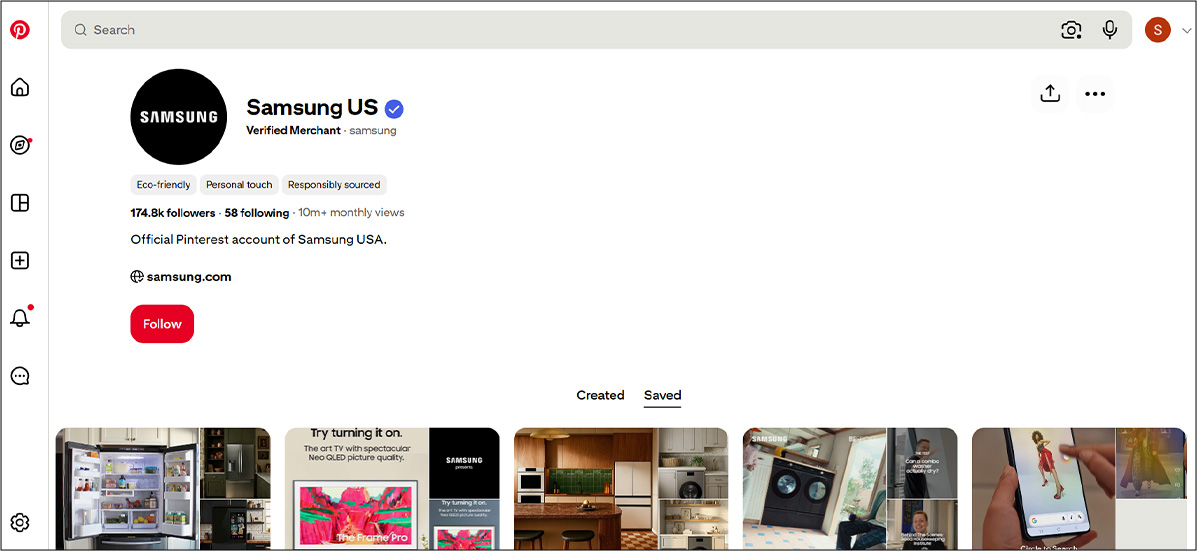
Samsung is a great example of this – everything is clean, clear, and instantly tells you what they are about.
Pro tip: Don’t try to be “unique” at the expense of being searchable. Pinterest is a search engine, not a personality contest. Clear beats clever every time.
2. Create Boards for Your Target Audience
Think of your Pinterest boards like sections in a shop. If everything’s dumped in one pile, people leave. If it’s organized? They stick around, click more, and follow.
Start by creating boards based on what your target customers are actually interested in – not just what you sell, but the world around it. Well-structured boards make your whole business Pinterest presence easier to explore.
- Clear, specific board titles (not vague, not cute)
- Short descriptions using keywords people would actually search
- Topics that match real problems, ideas, or desires
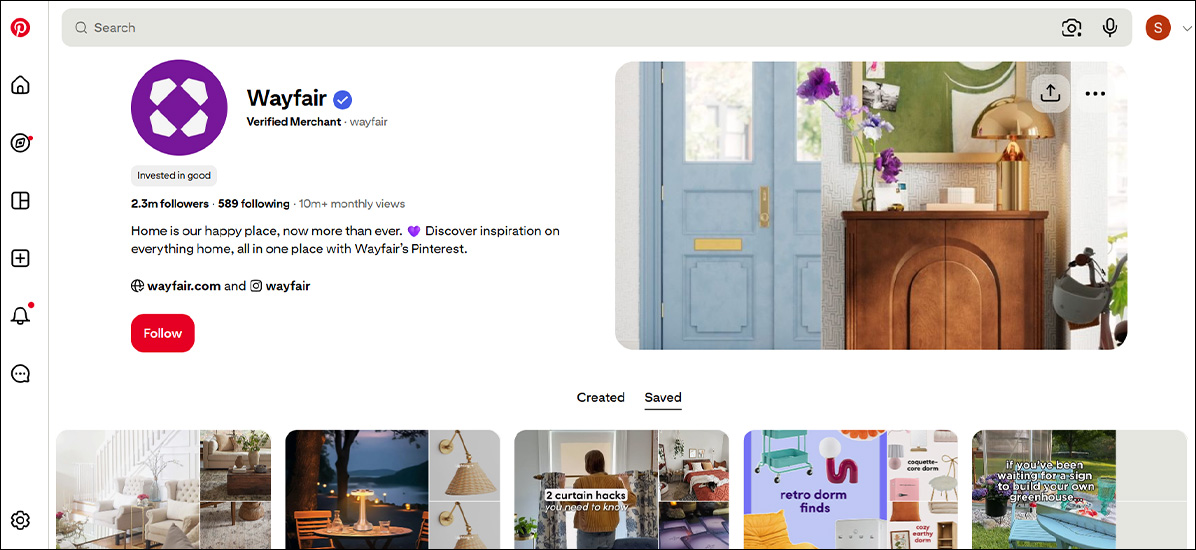
Have a look at Wayfair’s boards for a masterclass in this – everything is organized in a way that makes you want to click deeper.
Pro tip: Don’t overcomplicate it at the start. 5–10 solid, focused boards beat 30 chaotic ones.
3. Design Pins That Stop the Scroll
This is where most people either win… or completely disappear. Because on Pinterest, if your pin images don’t grab attention instantly, they’re getting ignored.
You don’t need to be a designer – you just need to follow what works:
- Vertical format (2:3 ratio – think 1000 x 1500 pixels)
- Clear, bold text overlay (tell people what they’re getting)
- Strong contrast so it’s readable on a tiny screen
- Consistent colors and fonts that match your brand.
These aren’t random rules – they’re how you create Pins that actually get noticed, saved, and clicked. Also, mix up your Pin formats. Static works, but video Pins and carousel Pins can seriously boost engagement because they give people more to look at (and more reasons to stop scrolling).
Pro tip: Don’t just design one and call it a day. Create Pins on Pinterest in a few different styles for the same link – Pinterest loves variety, and you’ll quickly see what actually lands.
4. Enable Rich Pins
Right now, your Pins look good. Great. But Rich Pins make them useful—and that’s what gets clicks. What these do is pull extra info straight from your site and stick it onto your Pin automatically. No manual updates. You change something on your site, it updates on Pinterest too.
Here’s what you can enable:
- Product Pins – show pricing, availability, and product details.
- Article Pins – pull in headlines, summaries, and author info.
- Recipe Pins – include ingredients, cooking time, servings.
- App Pins – link directly to downloads.
It gives your content context. And when people understand what they’re clicking before they click it, they’re way more likely to go through to your landing page.
To set it up, you’ll need to add a bit of metadata to your website (or use a plugin if you’re on something like Shopify or WordPress), then validate it through Pinterest. Sounds technical – usually takes about 10 minutes.
5. Work with Influencers on Pinterest
Pinterest isn’t loud about it, but there’s a whole creator side to the platform – and tapping into it is a smart way to get in front of a new Pinterest audience without starting from scratch.
You’re basically borrowing trust. Someone’s already built an audience… you just show up in the right way. Here’s how that can look:
- Collaborating on shared boards so your content appears alongside theirs.
- Sponsored Pins that feature your product or service naturally.
- Getting included in roundups, guides, or curated content.
- Long-term partnerships instead of one-off posts (way more effective).
The key difference here? It doesn’t feel like typical social media shouty promotion. Content on Pinterest sticks around, so those collaborations keep working long after they’re posted.
And because Pinterest users are actively looking for ideas, recommendations land a lot better – it feels helpful, not pushy.
Pro tip: Don’t just chase big names. Smaller, niche creators often drive better results because their audience is more specific, more engaged, and way more likely to care about what you’re offering.
6. Build a Community on Pinterest
Pinterest might not look like a typical “community Pinterest” platform, but it absolutely is. Just quieter, and way more action-focused.
If you treat it like a one-way posting machine, you’ll get poor results. If you actually engage? Different story. Here’s what that looks like:
- Comment on people’s Pins.
- Join group boards in your niche so your content reaches wider audiences.
- Encourage user-generated content by getting customers to share how they use your products or ideas.
This is how you turn passive scrollers into actual fans – and eventually, customers. Also, don’t sleep on things like Idea Pins. They’re built for engagement, storytelling, and showing a bit more personality, which helps people connect with your brand.
The more active you are, the more the Pinterest algorithm trusts your account – and the more it pushes your content out.
Pro tip: If someone saves or engages with your content, go check out theirs and Repin something relevant. It’s a small move that builds visibility and makes you part of the ecosystem, not just another account.
Grow and Promote Your Business on Pinterest
Next, it’s a case of making all those Pins work harder for your business and ensuring everything you put out delivers the best possible returns.
1. Post Fresh Content Consistently
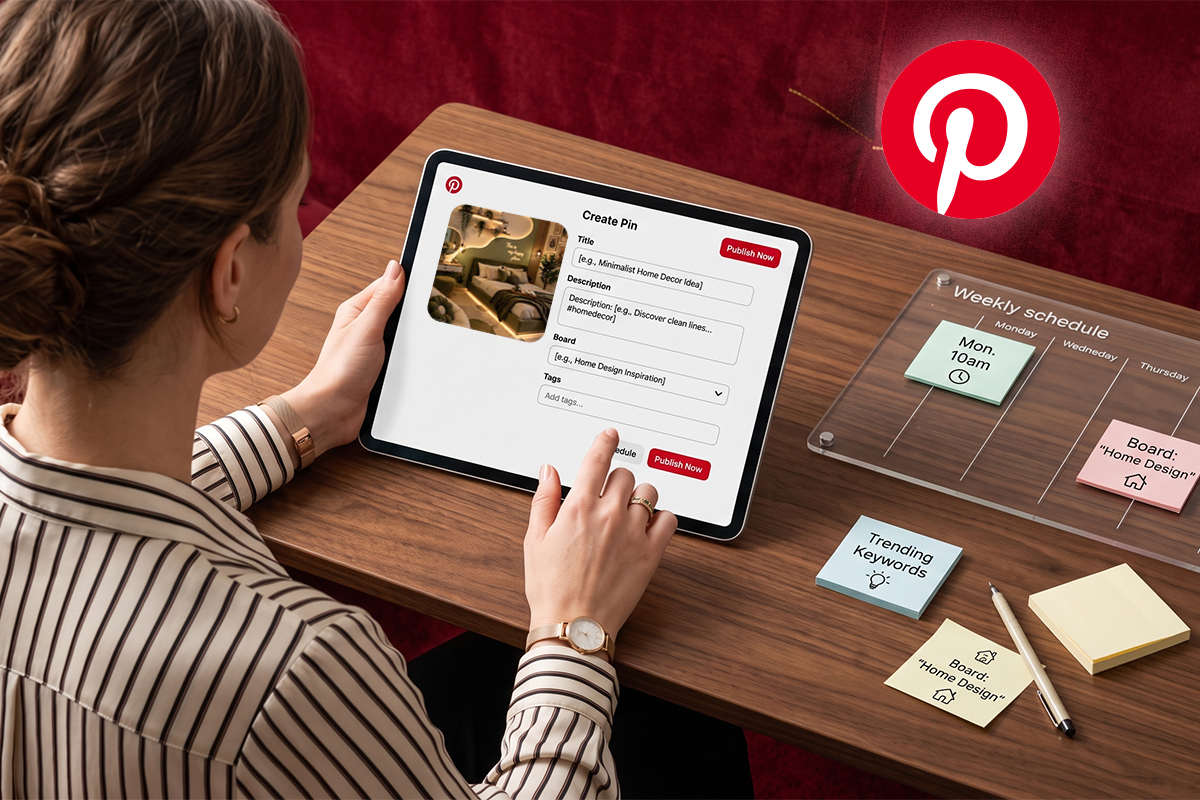
Pinterest loves people who show up regularly. Not once in a burst of motivation, then disappear for three weeks – consistently.
And “fresh content” doesn’t mean reinventing your entire business every time. It means:
- New Pin images for the same link
- Different designs, headlines, or angles
- New ideas spun from what you already have
You can send ten different Pins to the same page on your site, and Pinterest will treat them as ten separate chances to get discovered. This is how you stay visible without burning out – small, steady output that keeps you in circulation.
Also, this is where consistent posting matters. Not a perfect posting. Not “only when it looks amazing.” Just consistent.
Pro tip: Batch your content and schedule Pins in advance. One focused session a week beats daily chaos every single time – and your future self will be very grateful.
2. Drive Traffic to Your Website
This is where Pinterest quietly outperforms a lot of other social channels – it actually wants people to leave the platform. Every Pin is a doorway to your site if you set it up right.
First rule: Every single Pin should link to a specific landing page. Not your homepage – a proper, relevant page that delivers exactly what the Pin promised. Then make your Pin descriptions do some work. Add a clear reason to click, not just a vague sentence stuffed with keywords.
Strong CTAs that actually get Pin clicks look like:
- Read the full guide
- Shop the full collection
- Get the step-by-step tutorial
- Download the checklist
- See how it works
What doesn’t work? Overloading it, being unclear, or drifting into keyword stuffing that sounds like a robot wrote it. People scroll past that instantly. When your content lines up – good visual, clear promise, solid link – you don’t just get saves, you get actual traffic.
Pro tip: Match your Pin titles and visuals closely to what’s on the page. If there’s a disconnect, people bounce fast – and that kills momentum.
3. Sell Directly with Pinterest Shopping
This is where Pinterest stops being “nice for visibility” and starts pulling its weight. With Pinterest’s shopping features, people can go from browsing to actually buying without jumping through hoops.
Here’s how it works:
- Connect your online store to Pinterest
- Upload your product catalog
- Turn your Pins into product Pins with tags
- Keep your pricing and stock info accurate
Once that’s set up, your products can show up across the platform – in search results, on your pins, and in shopping surfaces.
It removes a ton of friction. No digging around your site, no second-guessing – just clear, clickable products right where people are already looking. And because users are actively searching for ideas and things to buy, it doesn’t feel forced.
Pro tip: Don’t just upload products and hope. Style them into real-life use – outfits, rooms, setups – so people can actually picture owning them. That’s what drives conversions, not plain catalog shots.
4. Run Pinterest Ads
If you want to speed things up a bit, this is where Pinterest ads come in. You’re basically taking Pins that already work and putting them in front of more of the right people – not just hoping they get picked up.
The good news? You don’t need a massive budget or some complicated funnel to get started. You can target people based on:
- Interests (what they’re actively into)
- Keywords (what they’re searching for)
- Demographics (age, location, etc.)
So instead of shouting at a random crowd, you’re showing up where people are already looking.
Pinterest advertising works especially well for product-based businesses because users are in that “I’m browsing but also kinda ready to buy” mindset. Start simple: promote a Pin that’s already getting saves or clicks. That’s your signal, it’s working.
Pro tip: Don’t run ads to cold, weak content. If a Pin isn’t performing organically, throwing money at it won’t magically fix it – test first, then scale what’s already doing well.
Measure Your Pinterest Performance
If you’re not checking what’s working, you literally have no idea if you’re getting it right. This is where Pinterest analytics comes in. It shows you exactly what people are doing with your content, so you can do more of what works and ditch what doesn’t.
Keep an eye on the stuff that actually matters:
- Impressions (how many people are seeing your Pins)
- Pin clicks (who’s actually clicking through)
- Saves (what people want to come back to)
- Follower growth
- Top-performing Pins
- Overall Pin performance
These are your key metrics – not just numbers, actual signals. Check in regularly, spot patterns, and adjust. The more you pay attention, the sharper your strategy gets – and the less time you waste on content that goes nowhere.
Most people treat Pinterest like a side project, something they’ll “get to” after Instagram, emails, and everything else fighting for attention.
That’s the mistake. Pinterest isn’t just another one of your social platforms – it’s the one that keeps working when everything else has already disappeared. It rewards smart, consistent action, not constant noise.
So if you’ve been stuck chasing engagement on social media and getting nowhere, this is your shift for increased engagement on pinterest. Show up, stay consistent, and let your content do its job long after you’ve logged off. Because the real win here? Getting found by people already looking – not begging to be noticed.
FAQs
1. How often should I post on Pinterest for business?
Aim for consistent posting rather than high volume. Around 5–10 Pins per day is a solid starting point, but quality matters more. Focus on fresh content, test what works, and adjust based on performance.
2. What types of businesses do well on Pinterest?
Pinterest works best for visual, idea-driven niches like fashion, food, travel, beauty, and home. But any small business can succeed if it creates helpful, searchable content that solves problems or inspires action.
3. Can I sell products directly on Pinterest?
Yes – Pinterest’s shopping features let you tag products on Pins so users can buy directly. It’s ideal for product-based businesses wanting a smoother path from discovery to purchase without extra steps.
4. How can I earn money through Pinterest?
You can earn through product sales, affiliate links, driving traffic to your site, or promoting services. Focus on creating valuable content that attracts the right audience, then guide them toward clear offers or actions.